

Weekly Edition 3-12-2026
March 11, 2026
NFHS Rebel Players Bring On the Creepy and Kooky with The Addams Family, March 19-22
March 13, 2026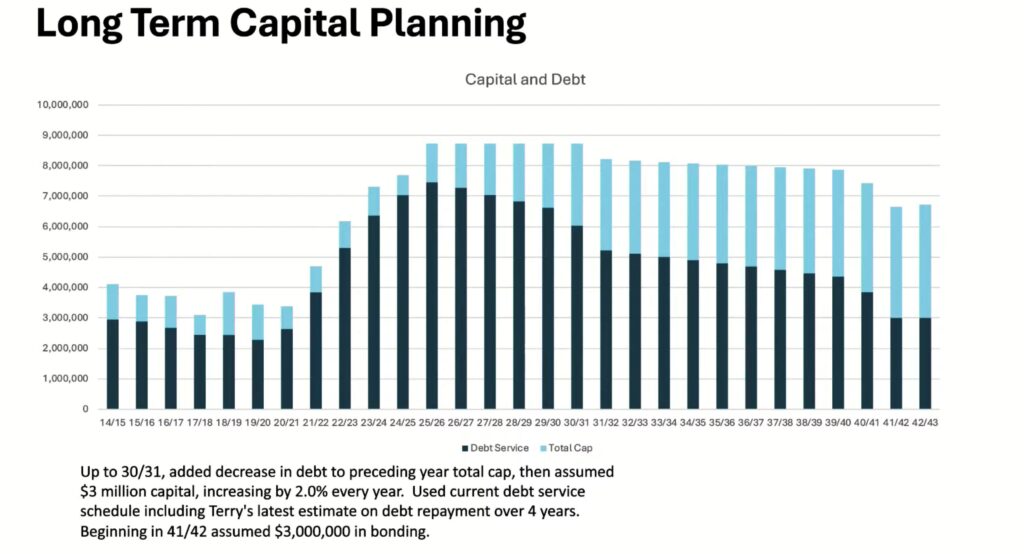
By Sarah Opdahl
NEW FAIRFIELD – On Sat., March 7, the annual Board of Finance (BOF) public hearings were held for both the Town and the Education FY 2026/2027 proposed budgets. At present, both budgets carry increases, with the Board of Education (BOE) pointing to mandatory fees as the reasoning behind the rise, and the Board of Selectmen (BOS) explaining that they are attempting to right previous missteps in underfunding. Town and school leaders laid bare the priorities of each budget, which stand at a proposed $59.1M, or a 4.32% increase, for education, and $16.2M, or a 9.92% increase, for the Town.
The hearings provided a kick off for the extremely active BOF budget season, during which every Wednesday evening the Board of Finance discusses the budget until eventual approval and it is brought to taxpayers. Now that the budget season is underway, requests for more information from the BOE and BOS are already flowing, following previous budget workshops and the issuance of the Town’s Budget Book. More questions were advanced by BOF members at the hearings.
NF BOE Proposes 4.32% Budget Increase, Points to Special Education Cost Increases as Primary Driver; NFMS Feasibility Study for Extensive Renovations Proposed
By Sarah Opdahl
NEW FAIRFIELD – In the school presentation, the budget was described by BOE Board Chair Mr. Dominic Cipollone as one that supports a “student -centered approach to teaching and learning.” He went on to laud the many accomplishments the school has achieved, from academics to the arts and beyond. Superintendent Dr. Ken Craw followed by describing the budget as allowing “us to continue the good work that we are doing in terms of continuous improvement.” He says that he and his staff, along with the BOE, have grappled with how the school district can continue to grow but do so in a fiscally responsible manner. He acknowledged that with any possible cuts they may need to “hold off to the future for other things that we think are important but incremental improvements.”
Craw shared, “the story of this budget has to do with some trends that we are seeing in special education enrollment. So, over the last five years, we have seen a 20% increase in the number of identified students. This trend is comparable to what is being seen across the state and across the country, and you can see that our enrollment has remained stable. We have had this increase in the K- 12 prevalence rate, which is the number of identified students divided by our total K-12 population that has been tracking very closely with the state.” He said of the mandatory costs, “We have had to think out of the box” about best ways to address students with more significant needs, as well as an increased number of students with special needs and a rise in types of those needs. Compounding the issue is an increase in the number of students on outplacements, which are very costly to the district in terms of tuition and transportation, both during the regular school year and summer sessions. Craw said that these outplacements occur when “it becomes a point where the behavioral needs or the clinical needs are so great that we need a more specialized program, but that doesn’t happen until we try and have exhausted all of our options here in the school system.” To address some of the issues, he explained that staff restructuring has already begun, and he presented a plan to restructure staff and programs that will address gaps in the system, such as the introduction of a Bridge program at the high school, which will be focused on therapeutic support and which may help to bring some of the twenty-one currently outplaced students back into the district.
There is a flat student enrollment projected for the next several years in the district, which certainly has drawbacks but among the positives is the ability to maintain near status quo for staffing. However, there are some programmatic enhancements that are being proposed. Craw said, “we are looking at incremental improvements in everything that we do here in World Language,” especially in the middle grades, to help get “our students to a level of proficiency at the high school level that gets them to speak in a conversational manner.”
The proposed capital budget is $623,000, which includes a feasibility study that would be conducted beginning this summer to analyze the costs of improving New Fairfield Middle School’s (NFMS) roof, HVAC, and mechanicals. It was billed as a way to investigate how to make this “the most affordable” for the Town, but it was also acknowledged that this includes projects that would be in the millions and would require bonding on top of the heavy debt service that is still owed due to the two new school buildings. It was stated that they are looking into what the potential impacts would be to the debt service. There were a handful of photos shown to support the signs of the middle school’s aging and to reiterate the need for smaller, more immediate improvements, such as turning the former cafeteria into music classrooms. When $150,000 was discussed to incrementally replace the exterior doors, some of which are in rough shape, BOF Chair Mr. Wes Marsh recognized the need and wondered why the district was not reallocating funds in the current year’s budget to cover the replacements and doing it immediately. However, Craw replied by explaining that a $400,000 deficit is currently projected in special education in this fiscal year, eliminating any options to reallocate.
BOF members had a number of questions, including about the plans and timeline for NFMS improvements; whether more could be done to appeal for financial help at the state level; the top-heavy structure of administrators at the schools; the lack of information in the district’s presentation about math and science performance; legal expenses needed for contracts and potential salary increases due to additional certifications; the current status and legal happenings surrounding the high school’s impactful propane failures; whether there is a rolling capital plan in addition to the oft-mentioned five-year plan; how the vision of a learner successes are tracked; and about tracking metrics for students after graduation.
Though public attendance was light, former BOF member Ms. Cheryl Reedy spoke at length about the education and Town budgets at the hearings’ end, saying, “I do hope that you do some work to try and bring this budget down. Speaking on behalf of taxpayers, I think we are all still, there is just a lot of uncertainty out there. And for middle class folks, they may say the economy is doing well, but groceries still cost a lot, medical costs a lot, and so forth. So I am hoping that you will hold it down.”
Town Budget’s Proposed 9.92% Increase Includes Exponential Rise in Capital Funding
By Sarah Opdahl
NEW FAIRFIELD – In the Town budget presentation, First Selectman Ms. Pat Del Monaco emphasized that she does not “put any extra padding in the budget,” but the capital costs proposed may draw scrutiny from BOF members. She started by saying that in the last few years, “Our recent focus has been on debt service, obviously, and the Board of Ed operating. I support that those were both very important things. We had two new schools that had to be built…We had students that were coming out of covid,” then she pivoted to state, “I’m asking now to add some focus on, specifically, the Board of Selectmen capital,” reasoning that “underfunding our capital now is going to have is going to result in higher costs later in either repair or replacement of infrastructure, and we are starting to see that.”
Del Monaco included a chart that supposes, given that the new school debt service will begin to decrease following years at its highest levels, the Town should now continue to budget for the full amount that was reached at the debt’s heights, with some projected stepped decreases, to start to address lagging capital improvement projects. In a departure from the decreases that were emphasized to residents throughout the original pitches for the school funding, Del Monaco said that she now believes “the debt and capital expenditures should move together. So, if your debt increases, your capital expenditures are going to be lower…I think that going forward, as this debt service decreases, we increase our capital expenditure number by the amount of that decrease, so we can eventually have a flat number, and that provides that stability,” she said. Del Monaco pointed out that there are revenue sources that would take some of this funding burden off of the taxpayers, such as interest income and cell tower fees. Selectman Ms. Khris Hall said, “the Town has underfunded capital for the Town for a number of years, and there is pent up demand. So, while it looks like a very big jump, if you average it over the last couple of years, it is not that big a jump. It is a hit in one year.” Selectman Mr. Jon Russo agreed that continuing to “kick the can down the road” is not a good practice.
This upcoming year’s capital expenses are targeted to address bridge and drainage repairs, but there are also plans for improved pedestrian safety with a crosswalk for the Senior Center, a Town Green feasibility study that would be associated with the proposed Marjorie Trail project, and other expenses, such as vehicles and equipment. There are plans to apply to the Hinman Family Charitable Trust to ideally fund the bulk of a pricey ambulance that is in need of replacement. Del Monaco noted that a study planned to analyze how best to use the Town’s Annex, which was recently vacated by school district staff, to help in planning for a new 600-square foot Town Clerk vault which will be located in Town Hall . The vault was first deemed out of compliance four decades ago and would be an $875,000 expense. She is hopeful that the State will cover the expense but, for now, it is in the proposed budget.
Regarding the operating budget, she said “the town has been fairly stable… there is not a lot there that changes year to year.” Almost half of the proposed budget is due to payroll increases, with contractual rises at 2.25%. She explained, “there were adjustments to shared services that caused an increase on the Town side in the finance budget, but it is a wash for the taxpayers because that was just a shift in who is paying more for finance services…The Registrar of Voters salaries have increased by $21,673. That is mostly due to the requirements for early voting.” There is a proposal to add an eighth officer to the Police Department to “get closer to optimal staffing.” As of now, the overtime pay has skyrocketed without the eighth position in place. There are also plans to restructure the Animal Control Department once again, returning to a full-time officer and keeping one part-time officer.
Del Monaco went on to explain that there are increases in legal expenses, in large part due to a $100 per hour increase in legal fees at Cohen & Wolf, from $150/hour to $250/hour. Also seeing increases are unclassified payroll and benefits, land services, equipment maintenance, fire department maintenance and repair, paramedics, EMT, and Public Works road repair. She went into great detail on the fire department’s equipment needs and EMT contract increase. Regarding Public Works road repair, she explained, “we are adding another $100,000…we do have some roads that have not overwintered well, main roads that, once they get to a certain point, and we have to mill those roads down before we can rebuild them, it gets very expensive.” There are also proposed increases to tech support and security services that will enhance network security, including geolocation filters, monitoring user traffic, antivirus, and managing multi-factor authentication. In TIn addition, there is a new small fee for translating services for Town personnel to rely on in communicating with non-English-speaking residents.
Board members questioned the Animal Control personnel planning; the ambulance grant funding; the legal costs associated with the propane failures at the high school and the playground failures at the elementary school; the possibility of Town service changes and reigning in costs for the police, fire, and Public Works departments; and the necessity and logistics of the vault was discussed.
In public comment there were questions from resident and BOE member Ms. Sue Huwer about what the plan is for bus lot funding, but that topic was punted, as the funding for that project is theoretically coming from the remaining school project monies. Del Monaco said, “there is still money remaining in the school projects, and we are discussing with the State how much money would be available from the State. So, this is not something that would appear in the Town [budget].” Mr. John McCartney reminded residents that the BOE budget is much higher than the BOS because they employ scores of staff. He also stated, “I want to just remind the Board of Finance in this Town specifically, I’m going to just say it, the Board of Finance has been very short sighted and have been responsible, in my opinion, for kicking the can down the road, and that results in much higher cost in the future. We cannot continue to do that. We have to budget responsibly for our Town, and we have to do the right thing for our Town.” Fire Chief Mr. Nick Conway spoke on behalf of the Fire Department’s request, imploring the BOF to fully fund the Equipment and Apparatus Reserves.
Former BOF member Ms. Cheryl Reedy, who resigned from the board last year in protest of the missteps of the Town’s former finance director, pointed out that the BOF has some positive elements to lean on this budget season: refinanced debt service, a better medical outlay than last year, the grand list increase, and “you have a finance director this year who has given you numbers that you can look at today and be confident that they are correct.” She implored the BOF to find cuts, as difficult as that may be, and “bring this budget down.” She said, “I want you to look carefully at all the nooks and crannies, you know, where they are, the property tax adjustment line, the revenue line that we have always been able to find a little bit in.” She was blunt in that any large unnecessary capital increases that were not in the five-year plan, three to five years ago, should not be escalated at this point. “Anything that shows up on a capital plan for the first time in a budget request that isn’t an emergency,” she said.
Reedy also agreed with Conway regarding the fire funding, sharing that costs have ballooned far beyond inflation to over 50% increases in many areas, given the changes in the industry with private equity companies having bought all competitors and now charging with abandon. She offered the BOF members a tour of the stations and welcomed a BOF member to serve as a fire liaison, saying the hope is to “get together a working group…to sit down and go over our 25 year plan, or the life of our equipment, our apparatus, is basically 25 to 30 years.”


