Weekly Edition 6-18-2026
June 17, 2026NF BOS Discuss Developing an Advertising Policy
June 19, 2026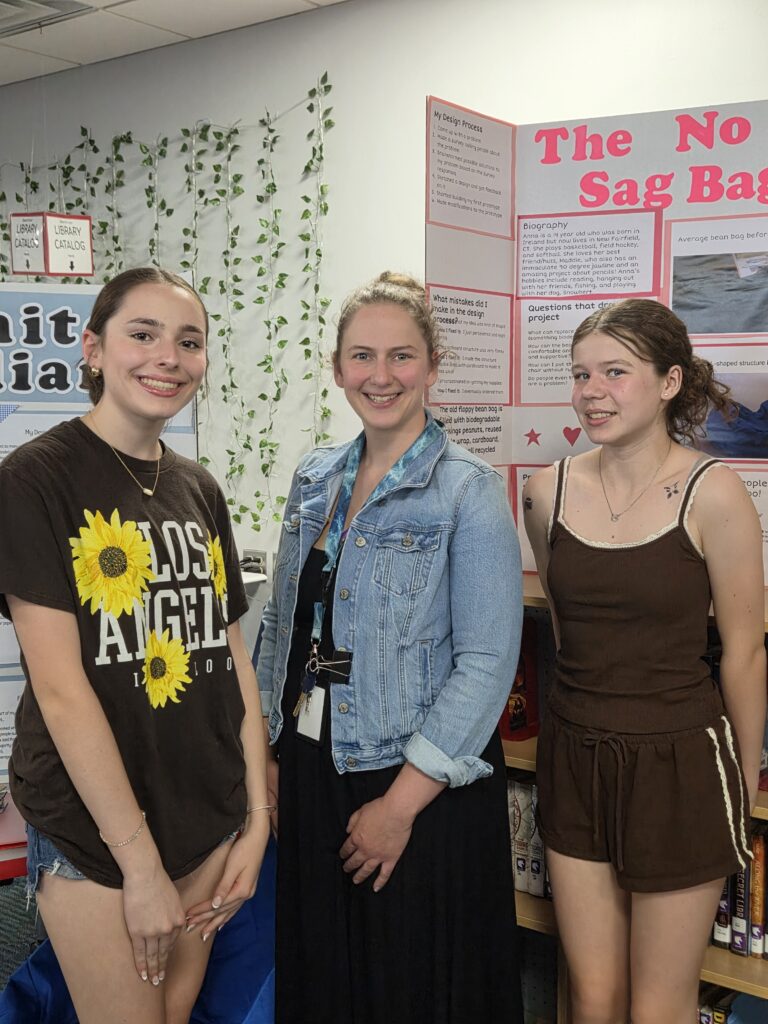
Annual REACH Showcase Celebrates Creativity, Persistence, and Real-World Problem-Solving
By Cherry Dumaual
NEW FAIRFIELD — When New Fairfield Middle School (NFMS) seventh-grader Jack Smith noticed that water filters throughout the school frequently needed replacement, he didn’t simply shrug and move on. Instead, he set out to understand why.
Over the next six months, Jack interviewed district facilities staff and plumbing professionals, researched water filtration systems, obtained a model of the school’s filter system, developed design concepts and explored ways to reduce the cost and labor involved in maintaining school drinking water systems.
His project was one of 26 featured during the annual REACH Project Showcase, where students in the NFMS Gifted and Talented Program presented six months of research, invention, and problem-solving to parents, family members, and friends. Twenty-eight students participated, with two pairs of students collaborating on projects because of shared interests and similar ideas.
Held in the NFMS library, the showcase transformed the space into a gallery of student innovation.
“It was filled with projects,” said Mrs. Emily Peterson, the school’s gifted and talented teacher. “There was just a nice, palpable energy and enthusiasm around the learning process and then being able to display the work that these kids have done over the last six months.”
Lining the library walls were project displays featuring inventions and solutions inspired by problems students observed in their classrooms, homes, school and community.
Solutions for Real-World Problems
Peterson structured this year’s projects around principles modeled after Connecticut’s Invention Convention program, encouraging students to identify real-world problems and develop solutions.
“Students were tasked with trying to invent something that would solve an everyday problem,” she said.
For Smith, that problem centered on the school’s water filtration systems. He learned that the school’s heavily used water filters expire quickly and that entire filter cartridges must be replaced. His project explored whether a redesigned housing could allow only the filter material to be replaced, potentially lowering costs and reducing waste.
What impressed Peterson most was not simply the idea itself, but the initiative Jack demonstrated throughout the process.
“He took the initiative to email the school’s Director of Facilities Joseph Lombardozzi. Jack would check the email with me to make it sound professional,” she said. “The student initiated it. Then he showed up, he had the interview, he had questions, he was very calm and composed. It was really amazing.”
Although Jack did not complete a working prototype before the showcase, Peterson views that as part of the learning process.
“Sometimes you don’t get to finish because it’s bigger than six months can allow,” she said.
Yet the experience taught him valuable lessons about engineering, research, communication, and perseverance — skills that extend far beyond the classroom.
Other students tackled challenges that may seem small but affect daily life in meaningful ways.
Seventh-grader Sebastian Knop created the “Shhh Sharpener,” a modified pencil sharpener designed to reduce classroom noise. Through repeated testing, he measured sound levels with varying amounts of soundproofing foam to determine whether his modifications could make sharpening pencils less disruptive.
Eighth-grader Maddie Schlosser tackled a different problem: lost pencils. Her invention, the “Graphite Guardian,” grew out of surveys she conducted asking students and community members how often they misplaced pencils and how they felt when it happened. She ultimately designed a magnetized holder that attaches to notebooks and keeps writing tools readily available.
Learning Through Innovation
For Peterson, the projects are about much more than the inventions themselves.
“They learn so much about the project itself and its content, but they also learn about how to navigate the difficulties when things don’t go the way they wanted them to go, how to pivot, and how to figure out what to do next,” she said.
That emphasis on resilience and independent thinking is central to the REACH program, which stands for Rebels Extend Achieve and Challenge.
Students remain in the program throughout middle school, allowing Peterson to work with many of them for three years. During that time, they learn to pursue their interests, ask questions, conduct research, collaborate, and communicate their findings.
One of Peterson’s favorite moments each year comes when families see the finished projects after months of hearing about them at home.
“I just love that everybody shows up, and it’s such a community feeling,” she said. “The parents are proud of their kids, and they’re proud to see what their student has done, but they’re also proud to see what everyone has done.”
She compares the experience to watching a student perform in a musical.
“You’ve seen the pieces, you’ve seen the rehearsal, and now you get to see the presentation,” she said.
Why Gifted Education Matters
The showcase also highlights something that makes New Fairfield distinctive.
While Connecticut requires districts to identify gifted students, it does not require schools to provide gifted programming. New Fairfield has chosen to invest in those opportunities through REACH, giving students a structured environment where curiosity and creativity can flourish.
Peterson believes the benefits extend beyond the students enrolled in the program.
“Research shows that when a school has a gifted program, the whole school does better,” she said. “It teaches the gifted students to be leaders, and then they can help lift others through their leadership.”
As parents moved from project to project throughout the library, they saw more than poster boards and prototypes. They saw students learning how to ask questions, tackle challenges, seek expert advice, and persevere when answers don’t come easily.
In other words, they saw young people discovering how curiosity can become innovation — and how today’s questions can become tomorrow’s solutions.
Learn more about the NFMS Gifted and Talented Program at www.newfairfieldschools.org/page/gifted/.
# # #
Thank you for sending this along. The student names are as follows: Jack Smith, Sebastian Knop (Shhh Sharpener, not pictured), Maddie Schlosser and Anna Needham, AJ Varbero, Hayley McNally and Liliana Gibbs.