
NF PBC Discusses Town Engineer’s Changes for Proposed Bus Lot Site Plan
February 22, 2026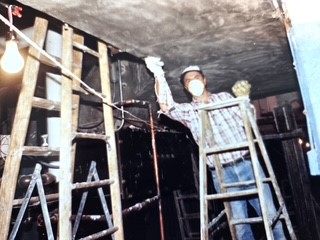
After more than 1,000 jobs, the 81-year-old continues giving back
By Cherry Dumaual
For Joe Zgombic, retirement didn’t mean stepping back. It meant giving back. This New Fairfield resident continues to put his extensive construction experience to work as a volunteer, helping others repair their homes. After more than 1,000 jobs over a lifetime shaped by hard work and perseverance, Zgombic shows how staying active and serving the community can define aging at its best.
Originally from Croatia, he immigrated to the U.S. as a teenager and spent decades working in construction, including as a foreman at the Jacob Javits Center for four years.
Soon to turn 82 in May, he remains deeply active, volunteering with HomeFront through St. Edward’s Church to help people in need to repair their homes. For one of their past projects, Joe replaced shingles at a Korean War veteran’s home in town.
NF residents in need can get more information about St. Edward Parish’s involvement with the HomeFront Project at stedwardchurch.org/homefront-project. HomeFront is a once-yearly program that offers free home repairs for individuals or families who may have no other recourse for making them. Homeowners are selected on the basis of need, with the stipulation that the house must be owner-occupied, with consideration for income parameters as well.
Joe’s Memoir: Over 1,000 Jobs
What intrigued me most about Joe was the memoir he likes to share with friends and acquaintances. The memoir’s title, “Over 1,000 Jobs,” is about the construction jobs he has held, first as a boy in Croatia, then as an immigrant in New York City.
Joe keeps his single-spaced, 15-page memoir in a binder, packed with stories about his family’s struggles during World War II, how they came to America, and how faith and years of hard work have helped their family stay together.
Born and raised in Krk, Croatia, in 1944, Joe and his family spent about two decades after the war living a life marked by fear, instability, and limited opportunity. The region endured constant political upheaval. With little freedom and few prospects, many families faced an impossible choice: stay and struggle or leave everything behind.
Like so many others, Joe’s family was part of a larger wave of emigration. Young people departed for Australia, South America, Canada, Germany, and especially the United States. Joe’s siblings found different paths to America, some risky and uncertain, before eventually arriving legally.
From an early age, Joe learned that work was simply part of life. He said, “Even when we were small, our father made sure we learned to work. We were always doing something; either we had to help mother in the house or garden, work with him on the land, take care of the animals, cut wood. He always wanted us to learn a trade because when he was here during Depression time, people with some kind of trade did well.”
Joe’s family could not afford the bus fare to high school so, at 15 years old, he began apprenticing as a bricklayer on a war-damaged hotel site. When he brought home his first paycheck, he placed it on the table, which made his mother cry, as it was the first earned income anyone in the family had ever brought home. For three years, Joe traveled by bicycle from job to job, learning his trade through hard, hands-on work.
A New Beginning in America: Hard Work, Falling in Love
To reunite the family and create opportunity, Joe’s father sold two cows and traveled to America, determined to secure a small pension and bring his children over. In 1962, 18-year-old Joe made the journey himself, arriving in New York after 15 days at sea.
Settling in New York with his father and uncles, Joe quickly looked for work. He took on whatever job he could find. Eventually, he found steady employment with a Manhattan construction company, where over five years he mastered multiple trades, such as bricklaying, cement finishing, plastering, and tile work.
Young, newly arrived, and still learning English, Joe often found himself leading older workers, needing to prove his skills again and again. At times, he worked alone, struggling even to find his way home.
Joe’s working life included building storefronts and restaurants around Lincoln Center, as well as department stores like Bloomingdale’s and Alexander’s on Manhattan’s East Side. His long workdays often blended into personal moments: rushing from a 15-hour Saturday job to a Croatian dance, where he met his wife Linda, and found joy in laughter, music, and connection.
Work was constant. Despite strikes, long commutes, and language barriers, Joe never missed work. He took night classes for years to learn English and saved whatever he could. He changed jobs when he had to, joined unions when opportunities finally opened, and started over more than once.
When he finally joined the Asbestos Workers Union in 1970, Joe began what would become a 22-year career insulating schools, hospitals, apartment towers, power plants, and subways across New York. He worked in bitter cold and climbed dozens of flights when elevators were down.
September 11, 2001, remains the hardest day Joe can remember. Like so many others, he mourns not only those who lost their lives, but also the countless people who were injured in ways that would surface years later, simply from being there, breathing the dust. Remembering, he said, “I was one of the first responders at the World Trade Center after 9/11. We were needed to insulate the water lines and work in the Verizon Building where a steel beam came crashing down and damaged the building, their telephone lines, and the air conditioning which was keeping them cool.”
Joe’s career path was not always fair or easy. After five years with Mission Construction, he tried to join the Bricklayers’ Union, only to lose hard-earned money to a false promise. Undeterred, he joined the Carpenters’ Union and took whatever jobs came, such as woodworking, installing cabinets, storefronts, and restaurant renovations. He was laid off more than once when work slowed, but each time he found another opportunity, another way forward.
Faith, Family and Perseverance
Family and faith anchored everything. Sundays were for church, long walks through Astoria with Linda, and quiet happiness. Joe never took time off until they married in 1969. They honeymooned in the Poconos, followed by an emotional return to Croatia to visit his parents. It was Joe’s first visit since he left in 1962.
In 1970, Joe’s long wait paid off when his number finally came up to join Asbestos Workers Union Local 12. Starting over once again as a helper, he embraced the work. Over the next decades, Joe built a career insulating schools, hospitals, apartment towers, power plants, subways, and major landmarks across New York City and Long Island. He worked through strikes, layoffs, and economic downturns, often stepping into foreman roles and running large jobs with care and discipline.
Some assignments tested him deeply, such as working at terrifying heights and witnessing injuries and deaths on job sites. Through it all, Joe was guided by one rule above all others: safety comes first. Through vigilance, he made it through 50 years of construction work without serious injury. He also credits Linda. “I managed to go without a scratch, maybe because I had a good wife to come home to.”
A New Chapter in New Fairfield
Joe and Linda raised three daughters and remained committed to church and community life. Linda got herself a part-time job in the school system, which later became full-time when the girls got older. She eventually became a school secretary, so she had a full-time job there and at home. It was an insurance policy in case Joe lost his job. When Linda retired, she received a small pension.
Joe retired in 2009 after 50 years of labor and almost four decades in the insulation trade. His union honored him with a pin and watch, and he now lives comfortably on the pension he earned.
In 2015, Joe and Linda moved from New Hyde Park, NY, to NF. They fell in love with the town, spending time with their youngest daughter, her husband, and their fifth grandchild, Lucas Pogmore, who was born here, and is a fifth grader at NF Elementary School. Today, Joe says he is doing “the easy jobs”—cooking, cleaning, gardening, and caring for their home. For enjoyment, he plays weekly chess at the NF Library and shoots pool at the NF Senior Center.
There’s volunteering, of course, to help those who need to make house repairs. After all, with more than 1,000 jobs in construction, Joe is ever ready to apply his skills and experience.
Joe’s service extends beyond construction. He volunteers with the Knights of Columbus and serves as a Sunday usher at St. Edward’s. Linda sings in the church choir and volunteers at the NF Thrift Shop. Joe also helps with Mother’s Day and Father’s Day breakfasts, distributes candy canes to youngsters for Christmas after Mass, and assists with other events. He often helps their next-door neighbor, who is almost 99 years old and a WWII veteran.
Joe’s piece of advice to his senior citizen pals? Write your memoir and share your story. “I have recorded my experiences for the benefit of my children and grandchildren. But I believe that all readers will find something valuable in my story because the lessons life teaches us are ageless and timeless.”
